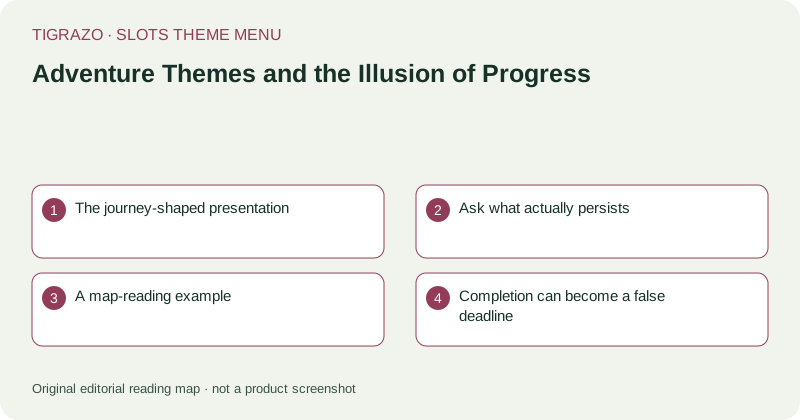
The journey-shaped presentation
Maps are persuasive because they give unrelated moments a beginning, middle and destination. In an adventure-themed slot, a path may connect animations that would otherwise feel separate. That can improve narrative coherence, but the path is not automatically a record of increasing financial value.
Some visible progression may correspond to a defined game state; some may simply decorate a transition. The distinction belongs in the rules. Do not infer persistence, eligibility or an approaching event solely from where a character appears on an illustrated trail.
Ask what actually persists
A meaningful progress description should answer what changes, when it changes and whether that change survives a session ending. If those answers are absent, describe the screen as a narrative device rather than inventing a collection system around it.
Even a genuine meter does not justify assuming that future independent spins are due to produce a desired symbol. The rules may describe conditional mechanics, but past disappointment alone creates no debt that the game must repay.
A map-reading example
Imagine a hypothetical screen with five islands, three illuminated and two dimmed. Before treating the remaining islands as unfinished work, check the information panel. The lights might identify already viewed scenes, a current feature stage or merely the background selected for this round.
- Locate the written definition of the island display.
- Identify whether it records a mechanical condition or a story sequence.
- Check whether leaving changes any stated entitlement.
- Do not assign money value to an unexplained light.
If the display remains unclear, uncertainty is a reason to stop interpreting it, not a reason to keep spending to discover its meaning.
Completion can become a false deadline
Adventure stories encourage closure. An unfinished route may therefore feel like an obligation even when no practical task remains. A personal stopping point should not move simply because the artwork shows another door, mountain or destination.
Separate the question of understanding a feature from the question of continuing a session. You can read an explanation, take a break or leave a scene unfinished. Narrative incompleteness is not a financial loss that further play can reliably repair.
How to curate this theme family
Useful adventure-theme notes discuss map clarity, character placement, progress labels and the distinction between decorative and functional indicators. Avoid presenting journeys as investments in an eventual outcome. The appeal can lie entirely in illustration and storytelling.
A well-read menu entry lets someone appreciate the world while recognising that a compelling destination does not predict the next result or determine when a session should end.