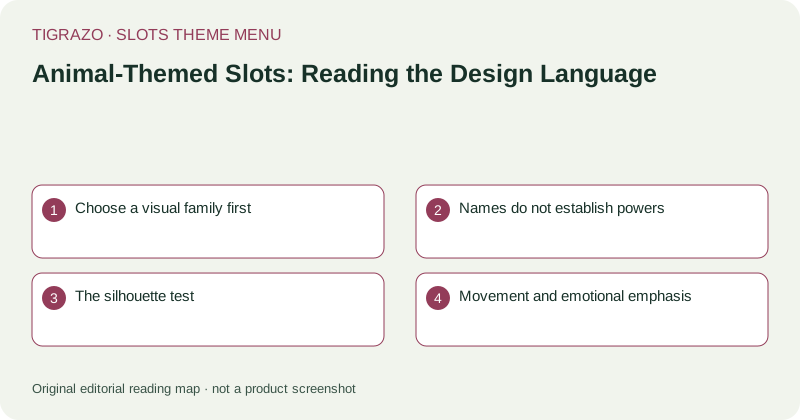
Choose a visual family first
Wildlife photography, painted safari scenes and cartoon pets create very different reading experiences. A realistic collection may use subtle differences in fur or feathers; a cartoon collection may rely on exaggerated outlines. Neither treatment is inherently clearer until you consider the size at which the symbols are displayed.
Describe the family precisely. Woodland animals, domestic companions and imaginary creatures are useful collection labels. Calling every animal theme wild can blur the distinction between an artistic description and a symbol that actually has a wild substitution role.
Names do not establish powers
A lion's association with strength does not make it a high-paying symbol unless the paytable says so. A rare animal in nature need not be rare on the reels. A bird's flight animation does not establish that it can move between positions during evaluation.
Read each special-symbol definition independently of the creature's personality. Where a substitution rule exists, check its exclusions. A familiar animal icon can still be subject to a narrowly defined role rather than the sweeping ability suggested by its animation.
The silhouette test
Imagine a hypothetical reel containing a wolf, a husky and a fox, all shown against blue circles. At a small display size, the shared ears and colouring could make rapid identification difficult. A useful comparison asks whether the animals remain distinguishable without relying on tiny facial details.
- Look for different overall shapes, not only different shades.
- Check the symbol key at the same screen size as the game.
- Notice whether motion temporarily hides identifying features.
- Confirm that labels explain any visually similar special symbols.
This test evaluates readability; it does not evaluate payout potential.
Movement and emotional emphasis
An animal may roar, leap or look toward the viewer after a result. These reactions can make an event feel unusually important. The animation's emotional intensity is separate from the amount recorded, and it should not replace checking the settled result.
Repeated motion can also obscure a control or compete with an information panel. If animations cannot be reduced through available settings, consider whether the display is comfortable to read. Comfort is a legitimate design criterion without becoming a strategy.
Writing the collection note
A helpful animal-theme menu describes habitat styling, contrast, movement and the clarity of the symbol hierarchy. It avoids suggesting that predators are aggressive games or that gentle animals imply low risk. Those are metaphors, not technical descriptions.
The final choice can simply reflect visual preference. Enjoying a particular creature does not supply information about the next spin, and changing the theme does not create a way to recover an earlier loss.