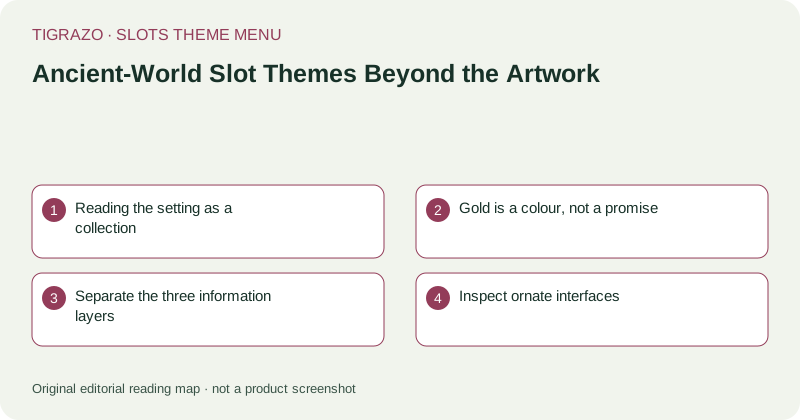
Reading the setting as a collection
Ancient-world themes often group columns, carved objects, masks and monumental buildings into a single visual palette. Those objects create continuity across a background and reel symbols. They do not establish historical accuracy, and they do not tell you how any combination is evaluated.
A careful theme label can describe the setting as inspired by an ancient civilisation without treating every costume or inscription as documentary detail. Some designs blend several periods or invent a setting entirely. That distinction matters for cultural literacy even when it has no mechanical effect.
Gold is a colour, not a promise
Gold surfaces can make ordinary symbols resemble special ones. A gilded border may simply unify the artwork rather than indicate an enhanced payment. Find the labelled symbol key and compare shapes, not just colour, before assigning importance to an object.
The same applies to gems and treasure chests. Their apparent rarity in a story does not reveal their frequency in a game. If a chest has a defined function, the rules should explain that function and any conditions attached to it.
Separate the three information layers
Consider a hypothetical temple screen showing a statue, a glowing doorway and a row of symbols. The statue may be background decoration, the doorway may be an animation, and one symbol may actually trigger a feature. Only the written definition establishes which layer controls the game.
- Setting
- Architecture and scenery that frame the presentation.
- Symbol system
- Recognisable icons with roles specified in the paytable.
- Feature explanation
- The conditions and effects stated for a particular mechanism.
Keeping these layers separate prevents a dramatic animation from becoming an invented rule.
Inspect ornate interfaces
Carved lettering and textured panels may be attractive at full size but difficult to read on a narrow display. Check whether numbers remain distinct from their borders and whether the help panel uses clearer typography than the decorative title treatment.
Watch for a control placed against a busy wall pattern or a stake label styled like part of the scenery. The important issue is whether a reader can identify the current setting without guessing. A plain information overlay can be more useful than an immersive frame.
Curating the ancient-world shelf
Compare these themes through palette, icon separation, readable numerals and the treatment of fictional history. Avoid using words such as powerful or fortunate as if they described measurable game behaviour. A convincing temple is an artistic achievement, not evidence of favourable odds.
When a setting invites further reading, keep that curiosity separate from play. Interest in a civilisation does not require continuing a session or unlocking another animated room.