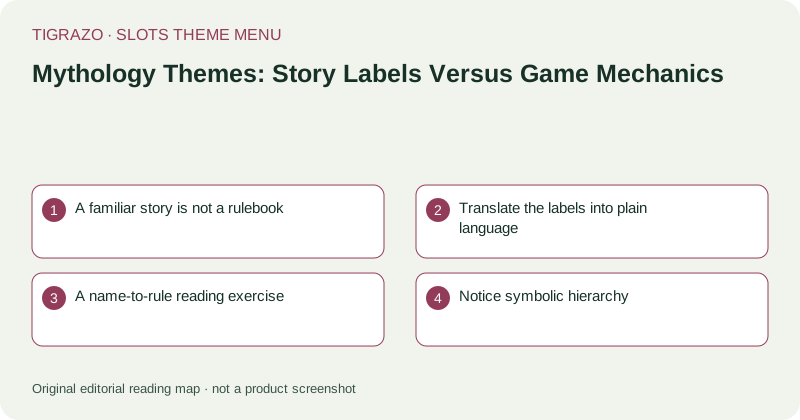
A familiar story is not a rulebook
A thunderbolt, enchanted weapon or messenger figure may carry a well-known meaning outside the game. Inside it, the object has only the mechanical role stated in the information panel. A dramatic name cannot establish a substitution rule, multiplier or feature trigger on its own.
Mythological traditions also vary across sources and regions. Artwork may simplify or combine them for visual effect. Treat the setting as an interpretation unless reliable contextual material establishes something more specific; there is no need to turn a themed menu into an invented history lesson.
Translate the labels into plain language
A feature name can be memorable while explaining very little. Translate it into questions: what activates it, what changes during it, and when does it end? These questions remain useful whether the label refers to a storm, a sacred object or a heroic journey.
If a figure is described as wild, check the exact substitution scope. If an object is associated with a fixed jackpot, check the game-specific qualifying conditions. Neither category becomes universal merely because the imagery looks familiar.
A name-to-rule reading exercise
Imagine a hypothetical feature called a hero's blessing. That phrase could describe many unrelated mechanisms, or even an animation with no separate effect. A responsible catalogue note would not expand the name into an assumed benefit.
- Story label
- The memorable name used by the presentation.
- Trigger
- The stated condition that activates the mechanism.
- Effect
- The defined change to evaluation or presentation.
- Boundary
- Any duration, exclusion or limit described in the rules.
Fill those categories only with information actually supplied by the game. Leaving an unclear category unresolved is better than importing powers from the original myth.
Notice symbolic hierarchy
Large portraits and elaborate borders can make a character feel mechanically central. Yet a smaller icon may have the more important defined function. Compare the visual hierarchy with the symbol key so that artistic prominence does not become a mistaken ranking of payment roles.
Audio can reinforce the same confusion. A voice announcing a divine intervention is still presentation unless a clearly described mechanism explains what changed.
Curate the mythology collection
Useful menu categories include illustrated legends, monumental fantasy and character-led storytelling. Describe how easily symbols can be identified and how plainly feature labels are explained. Avoid terms that imply supernatural influence over independent outcomes.
A theme may be enjoyable because its stories are familiar. That familiarity should make the artwork easier to discuss, not make an uncertain result feel destined or a future spin seem owed.